

My last newsletter explained how creating an Expert Advisory Panel of wills and estates lawyers embedded collaboration into the way our team at Vale operates.
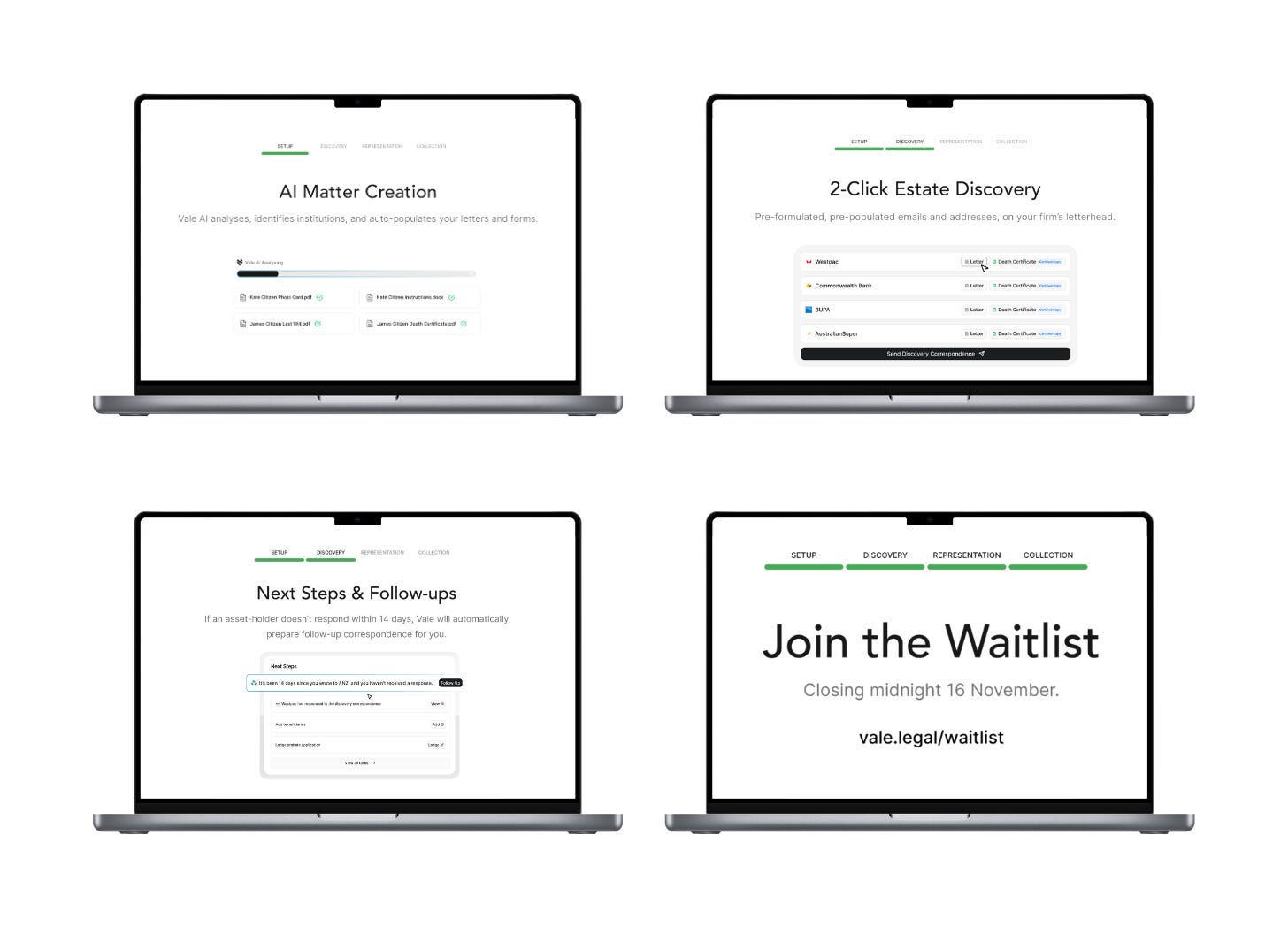
This week, we’re lifting the hood on how that collaboration has taken shape in three core features: AI Matter Creation, 2-Click Discovery, and Follow-Ups & Next Steps.
Probate is complex, nuanced, and increasingly demanding. Our research, summarised below, showed that most lawyers share similar frustrations: double-handling client data, repetitive estate discovery, and the constant effort of tracking institutional correspondence and matter progression.
1. Starting an Estate Administration Matter
The first challenge comes right at the beginning, when the matter is created.
For every estate, the same names and details are typed again and again across systems that don’t speak to one another. I’m talking practice-management software, correspondence templates, asset registers, and court e-filing systems to name a few.
You might type and re-type the same name and address 10 times in an hour (and that’s not including filling out asset-holder forms). More than half of surveyed firms in The Australian Probate Report 2025 identified double data entry as a major frustration.
It’s been over half a century since we walked on the moon; lawyers are right to expect more
Death certificates, wills, identification documents, and assorted financial records must all be manually entered and re-entered, often from a mix of PDFs, scans, handwritten notes, online forms, shoeboxes full of paperwork dumped on a desk…
Some digital intake tools can solve part of the problem, collecting client information online and exporting it as static PDFs, forcing practitioners to re-enter that same data manually.
Research with our Expert Advisory Panel revealed a whole host of issues to us that we wanted to fix. One of our Expert Advisors—Sarah Minter from Coulter Legal—was particularly engaged, showing a keen interest in what we might be able to deliver.
Sarah described how these inefficiencies compound daily: skilled staff spend valuable hours on repetitive clerical work, increasing the risk of transcription errors and diverting attention from meaningful client assistance. She needed a system that eliminated duplication without adding complexity: something that just works.
Sarah’s technologically proactive, having already reached for a handful of tools like AI note-taking software and to-do list apps. This got us wondering whether AI could read important information from documents—as opposed to from a client meeting—and then use that information to populate documents.
We created a prototype which was pretty mediocre, more of a proof of concept than much else. While it only got the job done with standardised, well-defined sets of documents, we demo’d it with Sarah.
“Most examples of AI seem to create more work or take the interesting creative work”, she told us. “The feature you showed was the first example of AI which had me excited! I think it might be the robovac of the tech world.”
She talked us through all the use cases for what we’d shown her, and that’s what gave us the confidence to invest in a proper build-out.
It wasn’t easy. It took dozens of iterations with a variety of AI models and custom back-end logic to get it working reliably enough to roll out. But when we rolled it out to Sarah, she was impressed.
With Sarah’s guidance, Vale’s AI Matter Creation feature now automatically extracts information from client documents and populates all relevant fields: names, addresses, executors, beneficiaries, assets, liabilities, and key dates across matter files and forms. No double-handling. No re-typing. No endless cross-checking.
We even added a “review stage” to make it easier for our users to check the AI’s outputs, giving lawyers total oversight over the feature’s output.
2. Estate Discovery
We’d figured out how to create a matter by just uploading the documents you already have. But the next hurdle...
Discovery.
Contacting banks, share registries, super funds, aged care homes, crypto exchanges and everyone else, confirming assets and balances one letter at a time.
Discovery is a problem. This is an area where “access to justice” falls down in probate. The Australian Probate Report 2025 found that more than 90% of lawyers would conduct more comprehensive estate discovery if it were more cost-effective. This means that assets are probably getting lost in the inheritance process! How much? No-one knows!
Again, let’s put this into perspective: With a $5.4T intergenerational wealth transfer occurring over the next two decades, facilitating effective and comprehensive discovery is crucial.
Our research had already shown that while most probate lawyers were familiar with the Australian Death Notification Service and had used it at least once—the responses they got back from asset-holders were not fit-for-purpose for lawyers. So we already knew that there was both need and appetite here to streamline the discovery process.
We put on our thinking caps and drew a bunch of designs as to how we could optimise what lawyers were already doing, focusing on speed and simplicity. Then we road-tested our designs with our Expert Advisors.
One advisor who provided extremely helpful feedback was Emily Lane from Lane & O’Rourke. When describing her workflow, the inefficiency became infinitely more tangible to us. Working in a small firm doing an enormous amount of work, she and her colleagues were spending more time finding asset-holder contact details and email addresses than actually writing letters. For Emily and the Lane & O’Rourke team, every minute matters.

We were motivated to make the discovery process as easy as possible, and the outcome was 2-Click Discovery.
The feature automates the entire discovery process while retaining the trust and flexibility of practitioners’ existing workflow.
The feature draws from a verified database of over 2,000 institutions, each with current contact details, document requirements, and preferred correspondence formats. From the matter file, Vale auto-drafts a discovery letter for each asset holder, pre-populating not only the relevant matter information, but also the asset-holder’s contacts details, and sends it off! Two clicks, and every letter is out the door.
Practitioners can check and edit each letter before sending - just to make sure! And each item of correspondence is logged and captured within Vale to help track the progress of the matter, maintain visibility, and simplify follow-ups.
This system eliminates thousands of hours spent on administrative repetition across roughly 100,000 probate files each year. Emily put it simply:
“Every time I hit ‘Send Notifications,’ I’m reminded of Vale’s value.”
3. Next Steps & Follow-Ups
With matter creation and discovery now streamlined, our research highlighted where the next wave of inefficiency could occur: after discovery, when lawyers must track responses, chase institutions, and manage multiple staff across open files of varying complexities and progress statuses.
Lawyers on our Expert Advisory Panel described this phase as cognitively exhausting work that depended on memory, handwritten notes, or reminders scattered across systems. Firms operating at high volumes have developed their own systems to track matters as they progress, from shared spreadsheets to physical files being manually moved from one box to the next.
Most of the lawyers we spoke to had struggled to establish a workable system, with a lack of real-time visibility causing serious headaches.
But Amanda Weier’s team at Payne Butler Lang had established a system that worked extremely well for keeping matter progress visible and tangible. The problem was, it was paper-based.
Hearing from Amanda motivated us to develop a feature that would allow her the same level of visibility into matter progress that her current system provided, but in a digital form accessible anytime, anywhere at the click of a button. Something that would offer a matter-level view of correspondence that has gone out, what replies are due, what needs to happen next, and who is responsible.
So we set our sights on a lightweight system that could make Amanda’s physical and mental data visible in Vale.
The Follow-Ups feature was the outcome. Automated prompts replaced ad-hoc reminders, while the software tracks external correspondence and accountability by recording and monitoring letters, emails, and requests sent to financial institutions, share registries, and other asset holders. Each time correspondence is sent, the system records who it went to, when it was sent, and what information was requested.
If no reply is received within a set timeframe, Vale generates a contextual reminder prompting the practitioner to act—eliminating the need for spreadsheet trackers, inbox searches, or manual, paper-based reminders.
Amanda’s insights helped get Follow-Ups where it needed to be, but we wanted to take things a step further.
While Follow-Ups helps lawyers keep tabs on their correspondence with the outside world, many lawyers told us that what happens inside the matter can be equally disorienting. Once external correspondence is underway, practitioners still need to track their own progress, knowing what has been done, what’s pending, and what needs to happen next. This is where Next Steps begins.
Again, our Expert Advisory Panel gave us a clear indication of the complexities at this stage of estate administration. We unpacked what that internal navigation problem really looks like in practice with Asheetha Jelliffe from Bridges Lawyers, who described the mental toll of juggling multiple open matters—each at a different stage, with different documents, dependencies, and team members involved.
Even with strong internal systems, matter orientation was suffering from the same issues outlined above: more spreadsheets and ad-hoc reminders.
What she needed was immediate contextual awareness: the ability to open a matter and instantly see where it stood, what information was outstanding, and what task needed attention next. Asheetha needs her staff to hit the ground running, without having to rediscover everything about a matter every time it’s re-visited just to know what steps to take next.
Her feedback shaped Next Steps into an intelligent, dynamic roadmap within each file. The feature interprets matter data in real time and presents a sequenced overview—“awaiting bank response,” “prepare probate application,” or “request collection from super fund”—updating automatically as each step is completed.
This allows lawyers and their teams to maintain momentum and continuity, even when multiple people collaborate across files.
Amanda and Asheetha’s input helped us to create two features that facilitate high-volume, high-complexity workplaces, where supervision and continuity across team members are critical.
Together, Follow-Ups and Next Steps close the loop on a feature set that ensures matters are created quickly, that correspondence is sent efficiently and professionally, that nothing slips through the cracks, and that matters aren’t stalled by lack of internal transparency.
Wrapping up
All of these features—AI Matter Creation, 2-Click Discovery, Next Steps and Follow-Ups—have been shaped directly by the lawyers who need them.
We’ll share more stories from our Expert Advisory Panel soon. But for now, we’re proud to be building a platform that transforms insight into function, helping practitioners save time, reduce risk, and focus on what matters most: their clients.
If you’d like to see how Vale can transform the way your firm handles probate, join the waitlist here.