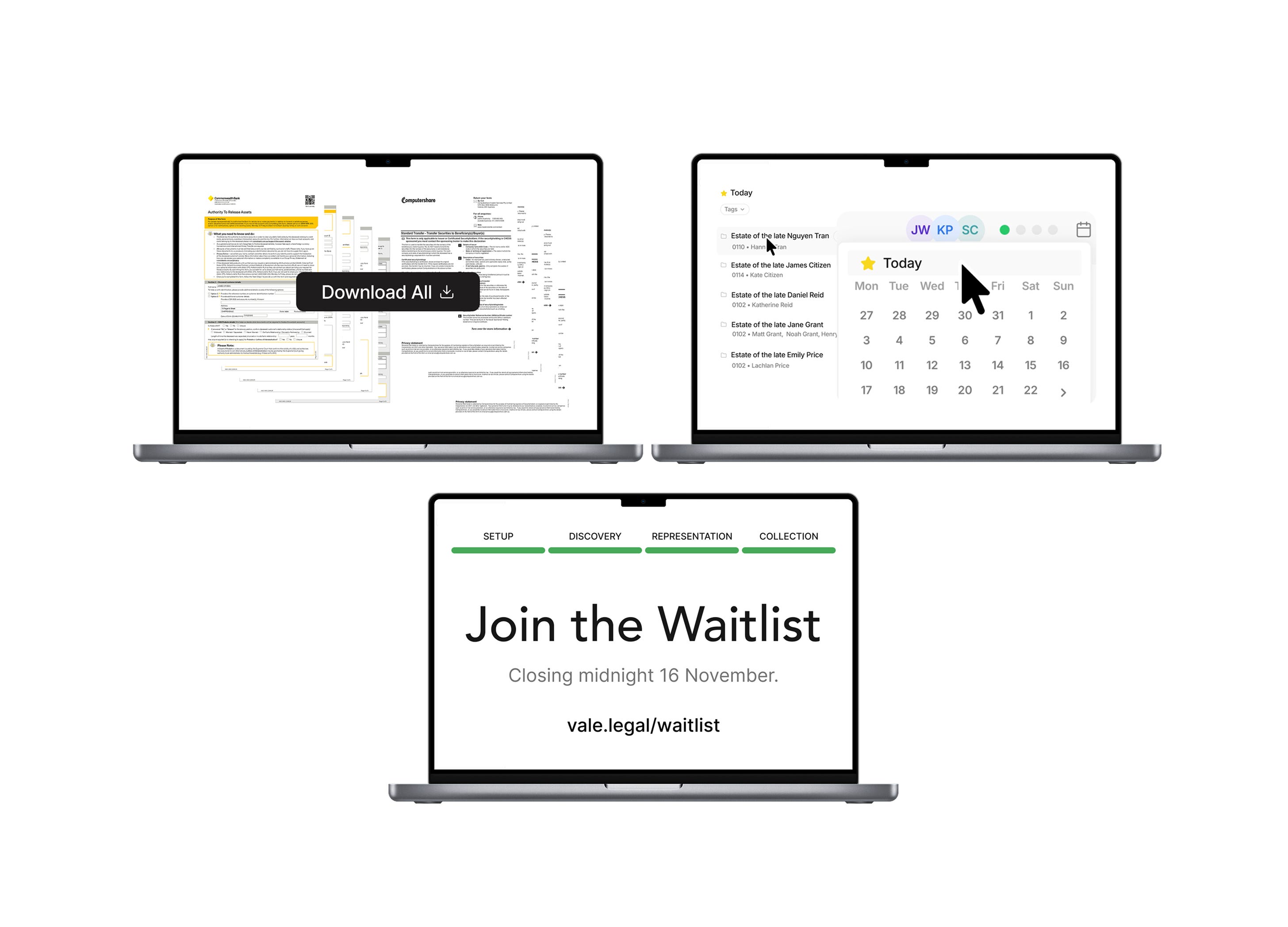
Last week, we took you through AI Matter Creation, Two-Click Discovery, and Follow-Ups & Next Steps—three features designed to remove early and mid-stage friction from the estate administration process.
This week, we’re moving deeper into the process, focussing on two more problems practitioners raised again and again:
→the administrative hell of asset-holder forms, and
→the chaos of managing dozens (or hundreds) of open matters at once.
Where pressure, time, and responsibility collide to create bottlenecks, we’ve consulted with practitioners to develop tools with the capacity to deliver a serious difference.
And thanks to the lawyers and clerks on Vale’s Expert Advisory Panel, we’ve been able to build solutions grounded in the way legal work is actually done.
300 Hand-Written Pieces of Paper
Pre-Filled Forms
Ask any probate clerk what they dislike most about their job.
The answer is almost universal:
Forms.
Forms.
Forms.
Every bank, every super fund, every share registry in Australia has its own deceased-estate forms.
They all ask for the same twenty or so pieces of information—but with different layouts, different requirements, and different rejection triggers.
A signature slightly outside the box? Rejected.
Ticked the wrong version of a form? Rejected.
Wrong date format? Rejected.
There’s a real emotional toll here. Lawyers feel trapped in a system that punishes trivial deviations in equal measure. Huge amounts of labour too often get torpedoed by systems that feel arbitrarily taxing.
When we asked lawyers and clerks across our advisory panel to rate this pain on a ten-point scale, the average response was 8.7.
That’s why we’ve worked with so many clerks. Senior lawyers have given us much insight, but clerks have a unique understanding of the administrative weight of this work.
Enter Tracey Justin: 30 Years, 28,000 Forms.
Over three decades across NSW and Victoria, Tracey has run hundreds of estate files a year. I estimate she’s completed 28,000 asset-holder forms. If each form takes just six minutes, this amounts to an entire year of her life entering the same information over and over again.
Clerks like Tracey experience the work from a unique angle. They know which forms stall for weeks, they know which banks demand certified copies, they know which registries reject signatures for touching the line, and which insist on older versions of forms that no longer exist online. Lawyers like Tracey have had decades to internalise information that most lawyers are manually googling day after day. We thought that the cognitive load and labour required to store or look up all this information should be made accessible to all practitioners in one place.
Tracey helped us understand not just the paperwork, but the flow of data inside a law firm:
how information enters, where it’s duplicated, where errors arise, where juniors get stuck, and where hours vanish.
With her guidance, we gathered every asset-holder form we could find from banks, super funds, share registries, platforms—you name it. We maintain a national database of these forms—a database built into Vale and available to all users. We organised them, coded their structure, and linked them to the matter data Vale already extracts.
The result is Pre-Filled Forms:
Vale identifies which forms each estate actually needs
It pre-populates them instantly with the correct matter data
It guides the user through institution-specific requirements
What used to take hours now takes seconds. What consumed months of a practitioner’s career now takes days.
When Tracey saw the early prototype, she said: “Tom, people are going to want this!”
Clerks know this work most intimately and it makes sense that they’re best-placed to understand the value on offer in a feature like Pre-Filled Forms. Tracey’s confidence in what we showed her gave us the confidence to build the system end-to-end.
If you’re not sure just how much of a difference Pre-Filled Forms will make, ask your clerks!
Managing Hundreds of Matters with Today/Upcoming
If forms are an administrative nightmare, then matter management is a mental one. This is what Today/Upcoming is tailored to tackle.
Every practitioner we’ve interviewed described some variation on the same scene: hundreds of open files, each at different stages, each requiring a different set of actions, each dependent on external timelines that don’t align, and with limited visibility between practitioners and clerks’ workflows.
Many lawyers still run practices predominantly on paper.
Some have expensive practice-management software with built-in task features that don’t cut the mustard.
Some rely on Outlook reminders, written lists, or memory alone.
Some are lucky enough to have clerks who hold the entire system together by force of will.
Everyone, in their own way, is improvising.
I didn’t know this when I started working for my Dad at O’Neill Solicitors, and was baffled by the administrative nightmare gluing probate practice together. What I’d encountered at O’Neills was one of thousands of systems resourcefully assembled to keep matters moving.
This is what a technologically under-served space looks like:
The workflow = the physical location of the file.
If the file is with you, you’re working on it.
If you hand it to someone else, you’ve passed the baton.
If it’s on the floor in the corner, it is scheduled for tomorrow.
Files in cabinets? Archived or waiting.
Piles on the left side of the partner’s office are tomorrow’s priorities.
Piles on the right: super-urgent.
The desk pile: do it now.
You don’t check a dashboard to understand the practice. You walk the office and look at where the files are breathing. These systems are powered by instinct, memory, and constant micro-judgments. Most juniors would have been told not to change a thing. Dad let me try.
At O’Neills, we split the tech stack into functional blocks: LEAP for trust accounting Xero for office accounting, SharePoint for documents, and Notion to host live dashboards, daily priorities, and task visibility across the team.
We could finally see, at a glance, who was working on what and where each matter stood. When COVID hit, we were ready to go remote while so many others were playing catch-up.
All these years, and thousands of hours of conversations about firm operations later, I get it: probate lawyers do not think in tasks. They think in matters.
Practice-management tools were interrupting the visual workflow that lawyers were used to, forcing them into task lists they’d never really wanted. This was the seed that grew into Vale’s Today/Upcoming feature, validated along the way by lawyers like Dan O’Connor.
Dan is a Partner at Bell Legal Group on the Gold Coast, and became an extremely valuable person to bounce our feature ideas off. When I showed him Today/Upcoming he laughed and pretty much told us that this is what he’s already doing in the calendar feature of his practice management software.
Dan had effectively re-invented the paper-pile system using the tools available, recreating the floor workflow the way so many lawyers are trying to do.
But in reclaiming their office space and digitising workflows, lawyers like Dan were still relying on tools that weren’t designed for matter management. A calendar is for appointments and deadlines, not for deciding which file deserves your attention today. Dan was shoe-horning a complex workflow into a tool that simply wasn’t built for it. He’d never had software that understood the problem deeply enough to solve it elegantly. That’s the gap Vale stepped into.
Discussions with Dan galvanised our conception of what Today/Upcoming is all about. So much of our efforts to streamline estate administration centre around reducing double-handing, human-error and cognitive load.
The process as a whole can’t just deliver clarity and efficiency in each isolated step—it has to culminate in an experience that helps lawyers zoom and and see the forest for the trees, and readjust priorities, before zooming back in on the detailed legal work.
In that sense, Today/Upcoming is where the compass needle stops spinning, and points lawyers directly where they need to go. Only, unlike a compass, Today/Upcoming responds to human judgement. You tell that compass which matters need your attention, just like Dan was already doing in his calendar. Only this time, all in one place, each matter contains within in a logical, step-by-step process informed by lawyers like Dan’s pre-existing workflows.
Move a matter into Today → it’s on your desk.
Move it into Tomorrow → it’s queued for the morning.
Move it into next Thursday → it disappears until Thursday.
Leave it in Anytime → it’s off your mind entirely.
Each matter carries its own date and its own “next step.”
The system reveals what needs attention today, hides what doesn’t, and mirrors the mental model lawyers have always used.
We’re not asking lawyers to change how they work. We just talked to lawyers like Dan, and found a way to give them their floor back that doesn’t force them to open and close 100 tabs to stay on track.
Today/Upcoming doesn’t ‘solve’ a problem as much as it merely organises solutions already being used to manage matters. It’s about ensuring that your estate administration process culminates in simple, resolute continuity, without imposing new systems, new rules, or deviating from what already works for lawyers.
Closing the Loop
As technology changes everything around us, estate administration has felt stuck.
Practitioners tell us in detail about lag, double-handing, institutional aches, and the burden of being hamstrung across digital and physical files. Difficulties in establishing office processes that don’t trade digitising for visibility crop up all over the country, with a huge variety of band-aid solutions improvised by firms keen to just keep the ball rolling.
In our research for the Australian Probate Report 2025, we found that 60.4% of surveyed probate practitioners reported using AI tools in the past 12 months, with most firms prioritising investment to streamline operations. Practitioners and clerks like like Michael O’Neill, Tracey Justin, and Dan O’Connor show us not only the value in tech curiosity, but demonstrate just how much of the work has already been done for us. But while years of trial and error, adaptation, and knowledge acquisition are there for technology providers to investigate, they’re going strangely ignored.
Working directly with the profession has given us the capacity to deliver a suite of tools that responds directly to their needs. It’s that simple. Collaboration is where value begets value.
The five features we’ve run through in last week’s and today’s newsletters are designed to help practitioners keep the wheels of succession turning. Each feature responds to issues faced by lawyers on the ground by harnessing their wisdom and modernising solutions improvised from firm to firm.
→ AI Matter Creation to eliminate double data-entry;
→ 2-Click Discovery to save time searching for estate assets;
→ Follow-Ups & Next Steps to reduce the mental load;
→ Pre-Filled Forms to save your hand from repetitive strain injury; and
→ Today/Upcoming to help you prioritise.
Consider the above features Vale’s starting point: a platform designed for wills and estates lawyers to deliver access, transparency, efficiency, and forethought to those whose time is better spent on the just, quick, and cheap delivery of legal services.
Join the waitlist before midnight this Sunday (16 November) and you’ll have a chance to use the product for free for the rest of the year. If you or your firm would like to become part of the conversation that is shaping the development of modern tools and technology for estate administration, joining the waitlist also offers access to our Partnership Program.